
#26 Computers are changing: RISC vs CISC architecture

We all know what computers are and what a CPU is, so let's zoom in and directly dive into the most important component of the CPU — the processor. You might have heard of transistors which triggered the development of computers in the last decades of 20th century. Modern processors are made of the same old transistors just that these are now very small in the range of a few nanometers and are arranged in a more efficient manner. For those who aren't familiar transistors are switches like on and off, just instead of on and off the output is bitwise i.e. 1 and 0. If many such transistors are arranged together in a particular format, we can make arithmetic calculations and even go much further to land humans on the Moon.
Scenario: The very first transistor was built in 1907 and was of vacuum tube type, it was 100 millimeters in size. Later in 1947 we managed to build transistors of size 100 micrometers, these are of the same type we use today, the only thing that has changed is their size reduced to 14 nanometer. Intel might soon be pushing it even more smaller, to 10 nanometers. But how small can we go? There's certainly a limit. Silicon atoms have a size of 0.2 nanometer, that makes the current transistor just the size of 70 Silicon atoms! We may not be able to go much smaller at least at the exponential rate we were till today and hence there must be other way of making computers more powerful. This is when the architecture pitches in — it is the way we arrange and use these transistors, and hence finding efficient way or minimizing the amount of transistors required could help us lower down the processor size [3]. The architecture we use in our desktops and laptops today is called Complex Instruction Set Computer (CISC) and the ones we use in our mobile phones are called Reduced Instruction Set Computer (RISC). The reason for this is not related to performance or something, until 2000s the applications of computers were fairly less complex than that of today. Hence the most complex programs of those times would still use average amount of power, and hence RISC and CISC didn't matter much and hence we sticked to CISC. RISC can also be known as ARM processors. The basic philosophy between these two is that RISC uses more memory and hence the RAM, while CISC uses more power. To differentiate these two consider following: You might have observed how smart phones are increasingly getting more comparable in processing power with desktops and laptops and still they don't have fans for cooling, while your high end desktops have two inbuilt and sometimes a external too. [1]
Why fans and no fans? RISC can comparatively use less power because every transistor can be operated at 1 clock cycle unlike for CISC. Hence every time CISC allocates memory, it also removes it after the process while RISC stores it until overwritten, these techniques save some clock cycle and power. Desktop's CISC architecture uses 125 W (Intel core i9) while a smart phone with RISC architecture just uses 5W (Apple A14)! Hence your smartphone is enough with a heatsink aka a metallic body. This crucial performance benefit is the reason why Apple is shifting it's laptop products entirely into RISC architecture, this will be done via their proprietary processor 'M1'. And yes, these laptops don't have a fan. [4]
Technical POV: The difference between CISC and RISC is that the former has variable instruction set lengths and the latter has fixed instruction set length. As a result an average single CISC command uses more clock cycles to compile than any RISC command. But this also has the drawback over RISC that the length of code is much bigger than CISC for the same type of job. Hence as we discussed above more memory is required in RISC.
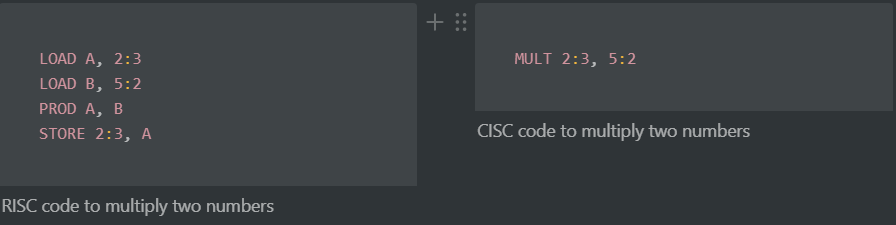
These drawbacks can be removed by designing specific caches for example to store most frequent compilations and hence reducing the length of code in RISC. Same can be done for CISC. These improvements are called micro-architectural enhancements. Hence rather than asking if RISC is better or CISC, the right question is which RISC and CISC architecture with micro-architectural enhancements is better, and hence it depends on which company actually develops them. [2]
Given the above paragraph we can say that Apple's new RISC processor topped by their proprietary micro enhancement tech might prove to be game changer for the workplace laptop products. While AMD and Intel powered CISC technology might still remain a powerful force in gaming and niche markets.